Save 80% on review costs with our new product Lattize AI — Human-centered. Transparent. Scalable. Consistent. Unbiased


AI Governance
The Fragmented Yet Converging Global Landscape
AI TECHNOLOGY
Yoke Yoon
1/5/20266 min read
As a founder building an AI-powered B2B SaaS platform, I have to think carefully about trust and compliance. The platform, Lattize AI, uses large language models (LLMs) to assist humans in reviewing and evaluating large volumes of data. While our primary focus is on business logic and objective evaluation rather than processing sensitive personal data, the increasing regulatory attention around AI made me pause and ask:
"What do these evolving global rules mean for companies like ours and for anyone building or using AI responsibly?"
Recently, I have been researching the emerging landscape of AI regulations and frameworks across different regions. What I have found is both complex and encouraging. While the details vary widely between countries, the world’s approach to governing AI is gradually converging around a few common principles.
A Patchwork of Rules Across the World
AI regulation today resembles a patchwork quilt stitched together by diverse jurisdictions:
The European Union (EU) has taken the lead with its AI Act, the first comprehensive legal framework classifying AI systems by risk level.
The United States (US) has a decentralized approach, combining voluntary federal guidance such as the National Institute of Standards and Technology (NIST) AI Risk Management Framework with emerging state-level initiatives such as California’s AI Transparency Act.
China has implemented strict controls requiring watermarking and registration of AI content.
Singapore is advancing with a certification-based trust model, while
India and Japan are adopting governance frameworks centered on ethical principles and accountability.
At first glance, this patchwork looks chaotic. However, beneath the variety of laws and policies lies a shared intention: To build AI systems that are transparent, fair, and safe for the people who rely on them.
Where the World Agrees
Across jurisdictions, several consistent themes have emerged that define the foundation of modern AI governance.
Transparency and explainability. Most frameworks require that organizations disclose when AI is being used and provide documentation that helps others understand how outputs are generated. The EU, Organization for Economic Co-operation and Development (OECD), and NIST all emphasize transparency as essential to accountability and trust.
Accountability and human oversight. Regulations increasingly call for a human decision-maker to remain responsible for AI outcomes. This ensures that decisions made with the help of AI can be traced back to a person or entity that can explain, justify, and, if necessary, correct them.
Risk-based governance. The concept of proportionate regulation is shared across the EU, OECD, and International Organization for Standardization (ISO) frameworks. The higher the potential harm an AI system could cause, the stricter the obligations become. High-risk systems such as those used in healthcare, finance, employment or education must undergo stronger validation and oversight.
Ethical and societal considerations. Fairness, non-discrimination, and respect for human rights are recurring values found in almost all frameworks. Even where the rules are voluntary, these principles are becoming a global baseline for responsible AI development.
Together, these ideas form a common core that is shaping how nations and organizations think about AI governance.
Where the Paths Diverge
Although the goals are similar, the means of achieving them vary significantly.
The EU has opted for a binding legal approach with explicit penalties for non-compliance. Its AI Act requires documentation, conformity assessments, and ongoing monitoring of high-risk AI systems.
In contrast, the United States continues to favor a voluntary model where frameworks such as NIST’s guide industry practice without legal enforcement.
China has taken a different direction by focusing on content control, requiring providers to label AI-generated material and conduct security reviews.
Singapore, Japan, and South Korea lean toward assurance and certification models that encourage compliance through transparency and testing rather than penalties.
Each approach reflects a region’s legal tradition and policy priorities. The result is a fragmented but interconnected system of governance that often references shared standards such as ISO/IEC 42001 for AI management and the OECD AI Principles for human-centered development.
Over time, these regional models are beginning to influence one another. European risk classification terminology appears in several Asian frameworks. The United States has adopted the language of trustworthiness and documentation, echoing OECD principles. The convergence is gradual but discernible.
Why This Matters for SaaS and AI Builders
For developers and organizations integrating AI into their products, understanding these dynamics is no longer optional. Compliance and trust are quickly becoming part of software quality, not external obligations.
Cloud-hosted AI services:
Many SaaS platforms rely on managed environments such as AWS Bedrock, Azure OpenAI (or other Direct Models), or Google Vertex AI. These providers already comply with a range of international standards, including ISO/IEC 27001, SOC 2, and FedRAMP. However, regulatory responsibility does not end with the provider. Platform developers must document how AI outputs are used, ensure that evaluation criteria remain explainable, and maintain traceable decision records. In most cases, this is the shared-responsibility model now adopted across the cloud industry.
API and open-source AI usage:
For SaaS platforms connecting directly to third-party APIs like OpenAI, Anthropic, or Cohere, compliance obligations depend on where and how the service is used. If the platform operates within or serves users in jurisdictions such as the EU, it may still fall under those rules even if models are hosted elsewhere.
Using open-source AI models on-premise or within a private cloud environment reduces data exposure risks but does not automatically exempt a company from compliance if users interact with regulated markets. In short, governance applies to use, not just location.
Sector-specific regulations add another layer. Healthcare, finance, and transportation sectors often impose additional audit, documentation, or validation requirements. This can make global scaling more complex for start-ups but also raises the quality bar for everyone.
The Global Picture
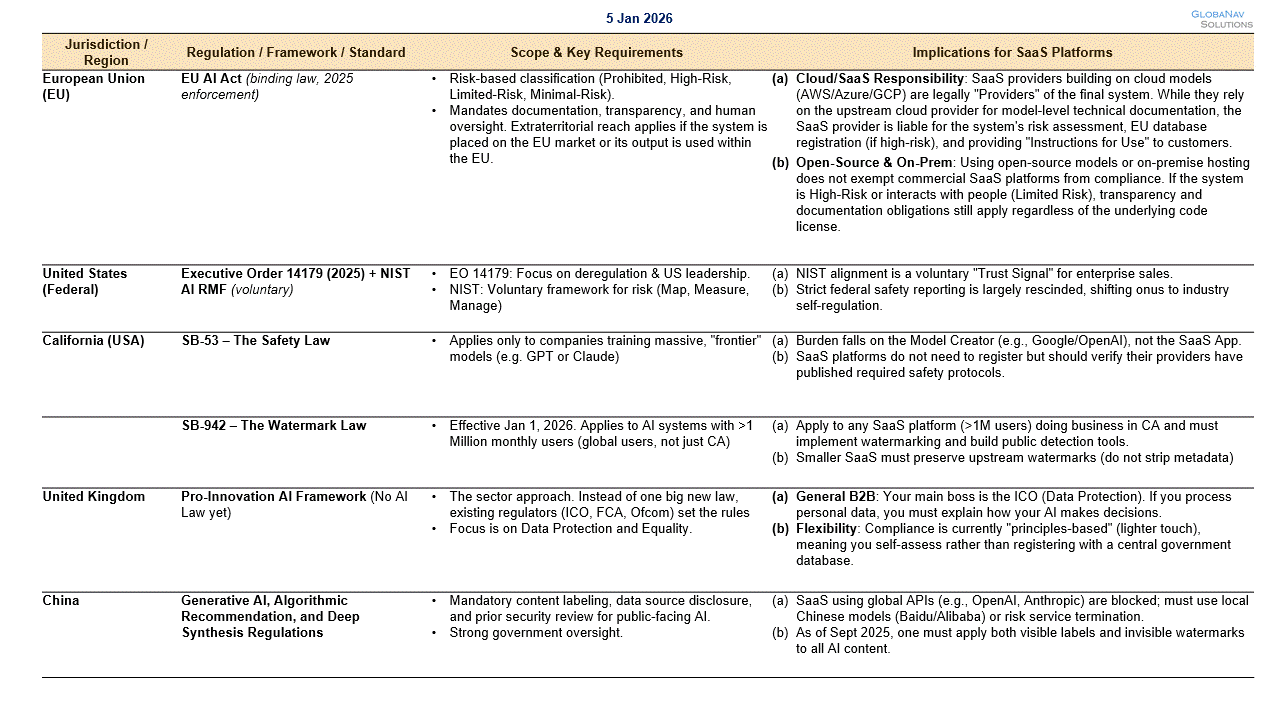
To illustrate the current state of AI governance, the following table summarizes major jurisdictions, frameworks, and implications for SaaS platforms.
Interpreting the Trends
The data show that although AI governance remains uneven, a recognizable pattern is emerging. Most regions share four foundational principles: (1) transparency, (2) accountability, (3) risk management, and (4) ethical fairness. These common values are being implemented through different mechanisms, but they form the basis of what could eventually evolve into a global interoperability framework for AI regulation.
The divergences lie in enforcement and scope. Some laws carry financial penalties, others rely on voluntary certification. Definitions of “high-risk” differ across regions. Yet the increasing adoption of common technical standards such as ISO/IEC 42001 and ISO/IEC 23894 suggests a slow but steady movement toward harmonization.
For SaaS providers, especially those serving international clients, the safest path is to align with the strictest applicable standard and maintain clear documentation of model use, risk mitigation, and human oversight. This not only supports compliance but also strengthens customer confidence.
Regulation as a Foundation for Trust
It is easy to view regulation as a constraint on innovation. In reality, it is becoming a foundation for sustainable growth. The more transparent and accountable AI systems are, the easier it is for businesses and customers to trust them. Compliance frameworks encourage practices such as reproducible workflows, documented evaluation criteria, and explainable results, all of which contribute to reliability and credibility.
As AI continues to integrate into decision-making systems across industries, the convergence of global governance principles will play a crucial role in ensuring that progress remains both responsible and inclusive. The conversation is ongoing, but the direction is clear: AI regulation is evolving from isolated national efforts into a connected ecosystem built around shared expectations of trustworthiness and accountability.
Looking Ahead
This article summarizes the current state of AI governance and the gradual convergence of global principles that shape how we build and use intelligent systems. Yet beyond the regulations and frameworks lies a deeper question that affects everyone who interacts with AI:
How much decision-making should we entrust to machines, and where must human judgment remain central?
The next step in this exploration is not about compliance or policy details, but about understanding boundaries—where AI enhances human capability and where overreliance may compromise accountability, fairness, or creativity. These are the kinds of questions that determine how responsibly we integrate AI into everyday business and governance.
By continuing this conversation, we can better define not only what trustworthy AI looks like on paper, but what it means in practice when humans and algorithms share responsibility for outcomes that matter.
Disclaimer: The information provided in this article and the accompanying table is for general informational purposes only and does not constitute legal advice. While we strive to ensure the accuracy of the content based on regulations published as of January 2026, laws and regulatory interpretations, particularly regarding the EU AI Act are subject to change. This content is not a substitute for professional legal counsel. GlobaNav Solutions assumes no liability for any errors, omissions, or actions taken in reliance on this information.
Connect with and Follow Us on
Copyright © 2026 GlobaNav Solutions LLC, North Carolina, USA